Japanese name (Kanji): 中山 色物
Name breakdown:
- 中山 (Nakayama) — one of the most famous eastern Kyoto mines (Higashi Mono), located in the Umegahata district. Operated by the Honma family; the mine is now closed though limited reopening under Hatanaka has been authorized.
- 色物 (Iromono) — visual/color attribute meaning "colorful things": abstract splashes of color (red, pink, violet, and other tones) on the stone's base color. Most commonly seen on softer Kiita stones. Iromono is a color descriptor, not a strata name. When no strata is listed, the stone is most likely from the Tomae layer by default.
Mining region: Nakayama mine, Umegahata district, Kyoto city (京都市右京区梅ヶ畑). An eastern Kyoto mine (Higashi Mono), part of the Hon-Kuchi Naori geological seam connecting Nakayama, Ozuku, Okudo, Shoubudani, and Narutaki. Stones from this mine are among the most sought-after JNATs worldwide.
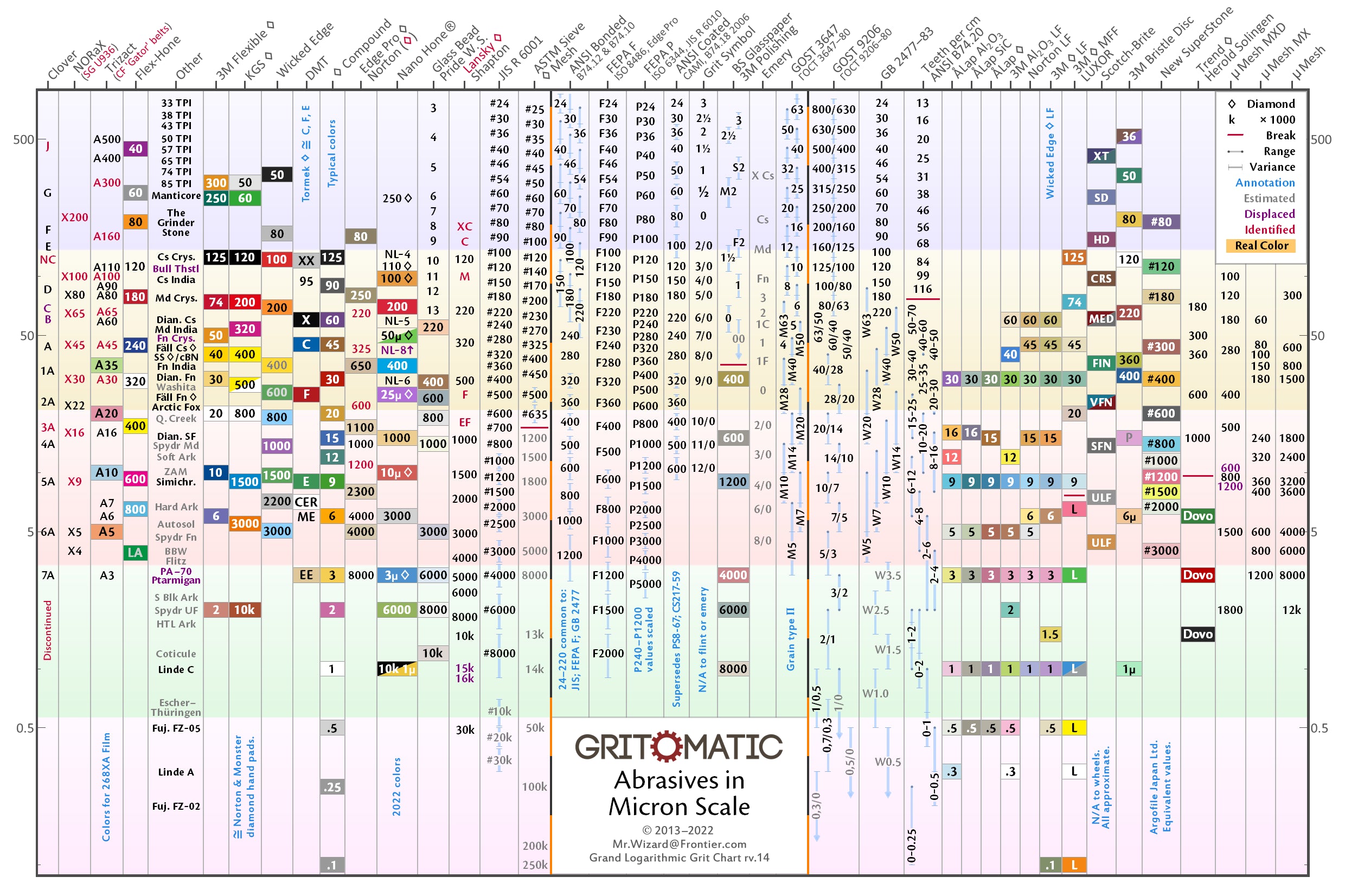
Grit rating (JIS equivalent): Approximately 6,000–10,000 JIS and above, suitable for finishing razor blades and high-carbon steel blades. A documented Nakayama Tomae Iromono Kiita Nashiji specimen measured grain size at 2.203 microns with hardness HS48, consistent with a high-end finishing stone. Nakayama stones at medium hardness (LV 3–4) correspond to approximately 8,000–10,000 JIS.
LV Hardness: Approximately LV 3–4 (medium to hard). Iromono coloration is most commonly found on softer Kiita stones, suggesting this particular specimen may lean toward the medium range, but Nakayama stones vary considerably. The stone described in collector listings as "kind of hard and condensed" with fast slurry production suggests LV 3.5–4.
Recommended progression: After a 6,000 JIS synthetic or a soft/medium JNAT Tomae. Suitable as a finishing stone for razors and high-quality kitchen knives. Does not require a tomo nagura or mechanical slurry-raising device in many cases, as the stone releases a good amount of black slurry on its own.
Composition: Siliceous shale, Hon-Kuchi Naori geological formation, Tomae strata (presumed). Iromono (色物) is a purely visual characteristic caused by mineral pigmentation during stone formation — red, pink, and violet color variations are due to iron oxide and other trace minerals embedded in the sedimentary matrix. It is not a mineralogical class of its own and does not inherently affect sharpening performance.
Steels to sharpen: Ideal for razors and fine cutlery requiring very high edge refinement. Effective on high-carbon steel (hagane) and stainless. Use with slurry and light pressure on soft iron cladding (jigane) to avoid scratching.
Usage recommendations:
- No soaking required — surface wetting only
- Stone produces a good quantity of black slurry relatively quickly; tomo nagura may not be needed
- Very smooth surface; maintain slurry throughout sharpening
- Not recommended for beginners — requires experience and controlled technique
- Before honing a razor, test for toxic inclusions (Kanesuji lines): run a soft metal or fingernail lightly across the surface and check for scratching; dark reflective lines warrant caution
- Iromono coloration with pink/violet patches should be checked individually — color variations may include harder mineral pockets
- Seal sides and base with cashew lacquer; do not soak


![Кенгуру шкіряна строп [6 "х 1"]](http://ua.gritomatic.com/cdn/shop/files/Kangaroo_20Leather_20Strop_206-inch_600x@3x.progressive.jpg?v=1764726765)
Ску: ROO-25
Наявність: На складі (180 предмети)
Тип товару: 6 "встановлений строп
Продавець: Gritomatic
Kangaroo Leather Strop is an efficient way of final polishing a cutting edge using guided knife sharpeners suitable for 6" stones. A leather strop enhances the cutting edge by correcting small nicks and smoothing grooves. The stropping medium is a...

Ску: HEXSCREWDRIVER-3MM
Наявність: На складі (58 предмети)
Тип товару: Аксесуари та інструменти
Продавець: Gritomatic
Many guided knife sharpeners include L-shaped Allen keys, the least expensive tool to handle hex screws. Hex screwdrivers are much easier to use than Allen keys. If you use your sharpener on a regular basis, hex screwdrivers will make your...
![Анодований алюмінієвий порожній [160 x 25 x 3 мм] [6 "x 1"]](http://ua.gritomatic.com/cdn/shop/files/anodized-aluminum-blank-160-x-25-x-3mm_600x@3x.progressive.jpg?v=1767522944)
Ску: TIAN-3MM-25-GRAY
Наявність: На складі (2970 предмети)
Тип товару: 6 "порожній порожній
Продавець: Gritomatic
Anodized Aluminum Blanks 160 x 25 x 3mm are used to mount 6" sharpening stones for guided knife sharpeners. Blanks are made of high-quality 3mm-thick aluminum with 45-degree bevels (Edge Pro form-factor) and color anodizing. Blanks are available in ten...
![Шкіряна коров'яка [6 "х 1"]](http://ua.gritomatic.com/cdn/shop/files/Fine_20Cowhide_20Leather_20Strop_206-inch_20_28thin_20blank_29_600x@3x.progressive.jpg?v=1762871472)
Ску: LEATHER-25
Наявність: Поза запасом
Тип товару: 6 "встановлений строп
Продавець: Gritomatic
Fine Leather Strop is an efficient way of final polishing a cutting edge using guided knife sharpeners. A leather strop enhances the cutting edge by correcting small nicks and smoothing grooves.The stropping medium is thin fine cowhide leather mounted on...
![Кенгуру шкіряна строп на анодованому порожньому [6 "х 1"]](http://ua.gritomatic.com/cdn/shop/files/multi-color-kangaroo-leather-strop-for-edge-pro_600x@3x.progressive.jpg?v=1767522952)
Ску: TIAN-ROO-25-BLACK
Наявність: На складі (2 предмети)
Тип товару: 6 "встановлений строп
Продавець: Gritomatic
Kangaroo Leather Strop is an efficient way of final polishing a cutting edge using guided knife sharpeners. A leather strop enhances the cutting edge by correcting small nicks and smoothing grooves.The stropping medium is leather pad made of vegetable tanned...